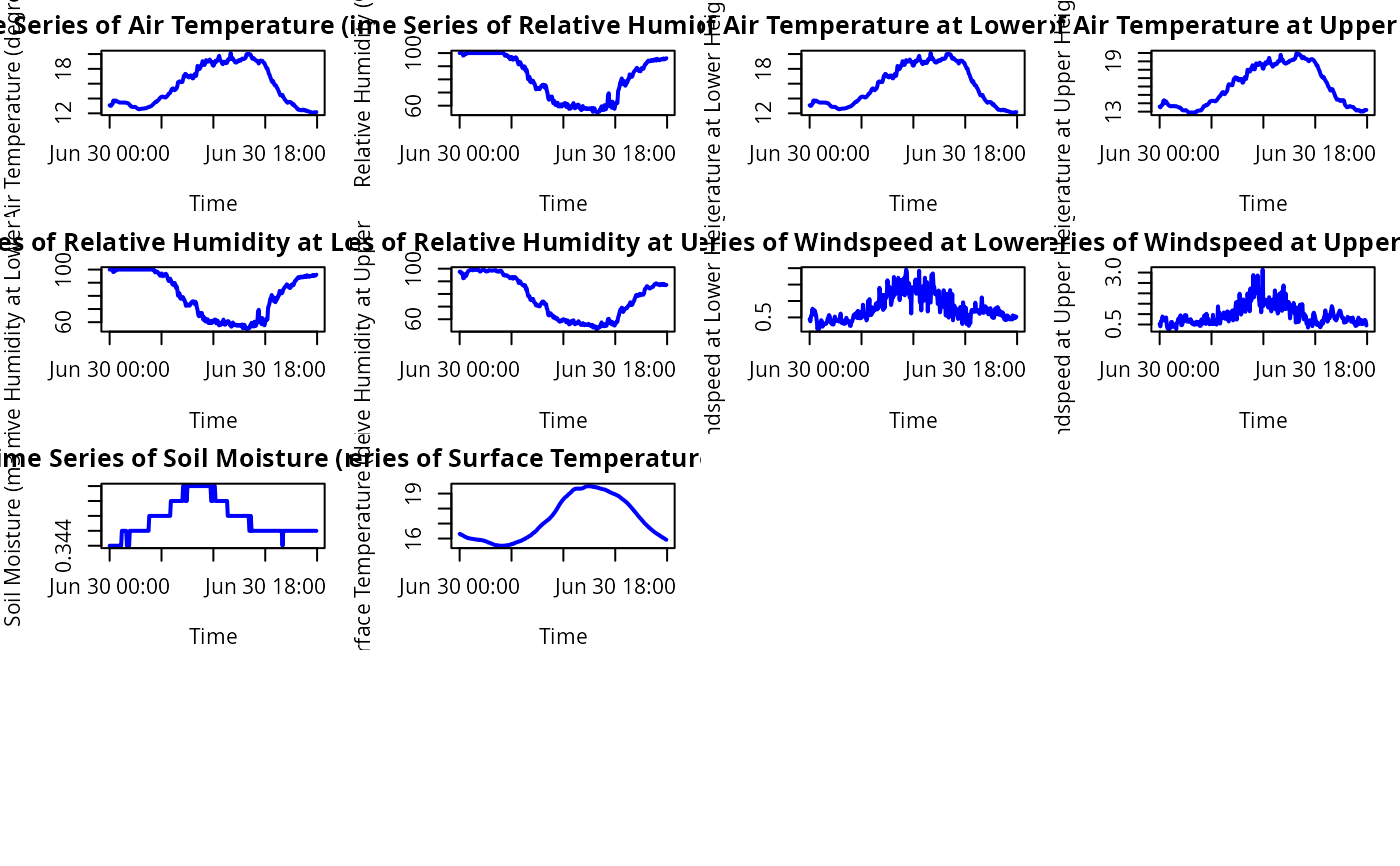
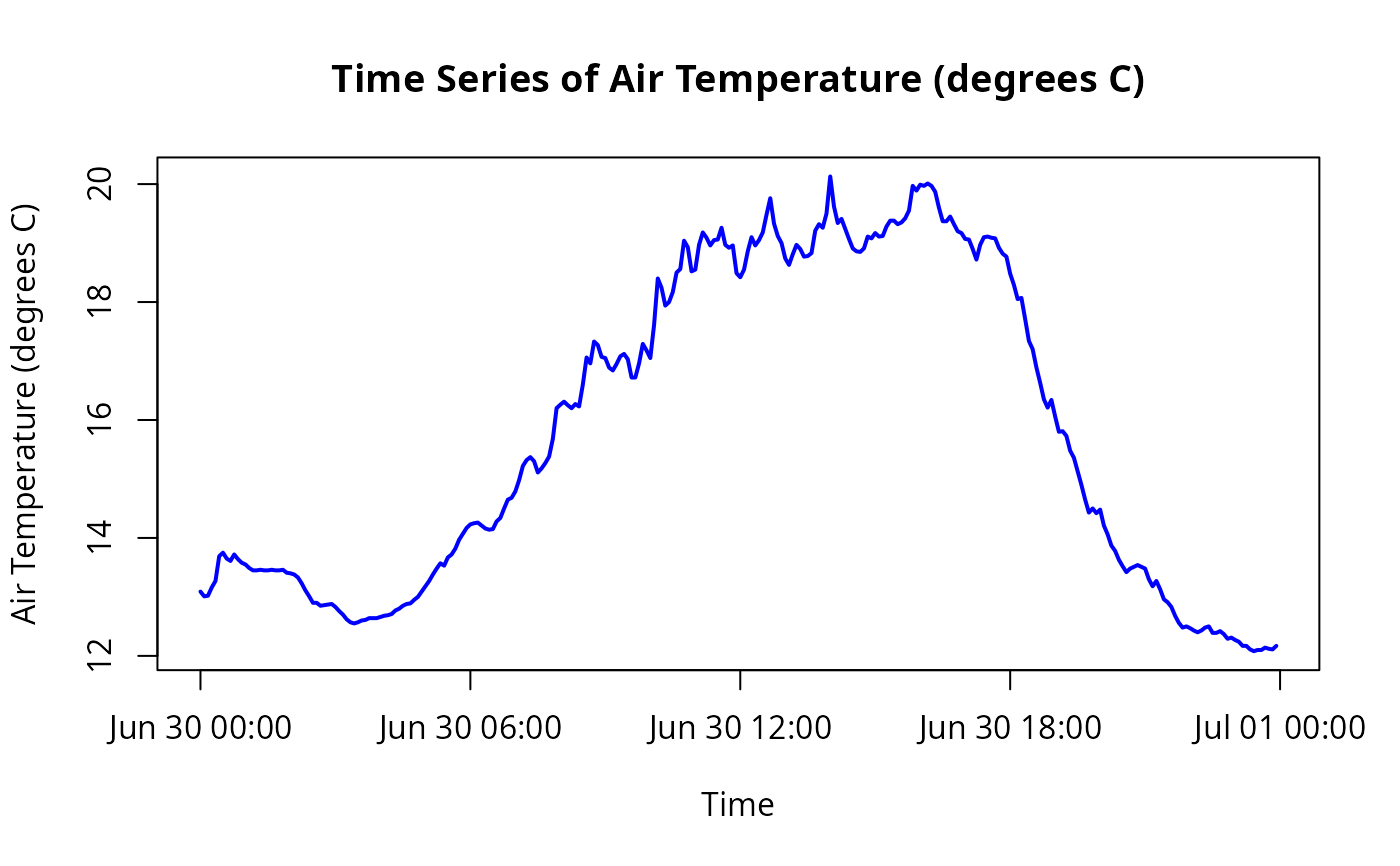
This function creates a time series plot of a specified variable from a weather station object. If no variable is specified, it will plot all time series variables in a grid layout.
Details
The plot_weather_station function generates a time series line plot for a specified variable within a weather station object. If no variable is specified, it plots all available time series variables in a grid layout. Non-time series variables, such as those with a single value or character data, are automatically excluded.
The function uses base R plotting functions to ensure minimal dependencies and simplicity in usage.
Examples
caldern_file <- system.file(
"extdata",
"caldern_wiese_2017-06-30.csv",
package = "fieldClim"
)
caldern <- read.csv(
caldern_file,
na.strings = c("NULL", "NA", "")
)
caldern$datetime <- as.POSIXct(
caldern$datetime,
tz = "Europe/Berlin"
)
ws <- build_weather_station(
# Time axis.
datetime = caldern$datetime,
# Station location.
lon = 8.6832,
lat = 50.8405,
elev = 261,
# Standard air temperature and relative humidity.
temp = caldern$Ta_2m,
rh = caldern$Huma_2m,
# Profile variables for gradient- and stability-related methods.
t1 = caldern$Ta_2m,
t2 = caldern$Ta_10m,
hum1 = caldern$Huma_2m,
hum2 = caldern$Huma_10m,
# Wind profile and measurement heights.
v1 = caldern$Windspeed_2m,
v2 = caldern$Windspeed_10m,
z1 = 2,
z2 = 10,
# Package names for theoretical flux terms:
# rad_bal corresponds to Q*, soil_flux corresponds to B.
rad_bal = caldern$Q_star,
soil_flux = caldern$B,
# Additional surface and soil information.
moisture = caldern$water_vol_soil,
surface_temp = caldern$Ts,
# Surface type as a model assumption.
surface_type = "field",
# Observation height for methods requiring a reference height.
obs_height = 2
)
# Plot air temperature.
plot_weather_station(ws, "temp")
 # Plot all available time series variables.
plot_weather_station(ws, NULL)
# Plot all available time series variables.
plot_weather_station(ws, NULL)